


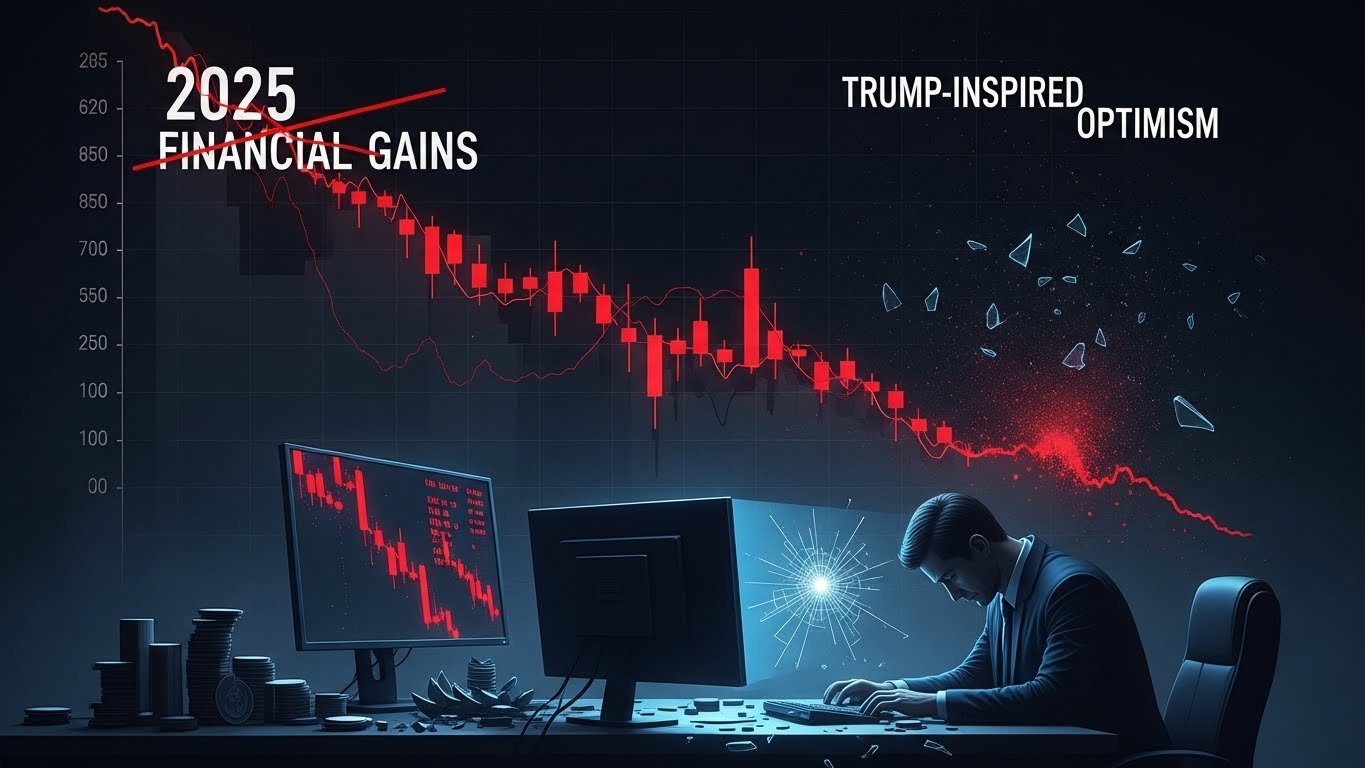

Few markets shift moods as quickly as crypto. One month, headlines celebrate record highs, institutional adoption, and a new era of legitimacy. The next, a cryptocurrency slump wipes out months of gains and sends traders scrambling for explanations. That emotional whiplash is part of what makes the sector so captivating and so dangerous. In 2025, the story has been particularly sharp: early-year momentum gave many investors the feeling that the market had finally turned a corner, only for a sudden downturn to erase financial gains and dampen the political optimism that some traders associated with a more crypto-friendly environment.
The phrase “Trump-inspired optimism” has become a convenient label for a specific kind of market psychology. It represents a belief that political shifts could translate into regulatory clarity, looser enforcement, and policies that encourage innovation. Whether that belief is realistic or exaggerated, it unquestionably became part of the narrative driving sentiment. But markets don’t move on narratives alone. When a cryptocurrency slump hits, the causes are almost never one-dimensional. Price action is usually the final outcome of several forces colliding at once: tighter liquidity, macro uncertainty, leverage unwinding, changing institutional flows, and a sudden drop in risk appetite.
What makes this particular cryptocurrency slump notable isn’t simply that prices fell. It’s what the reversal revealed about 2025’s crypto market structure. Traders learned—again—that rallies can be fragile when they rely heavily on momentum. Long-term holders were reminded that macro conditions still matter more than memes. And newcomers discovered the uncomfortable truth that crypto remains one of the purest expressions of market volatility in modern finance.
This article breaks down what the cryptocurrency slump means, why it erased 2025 gains, and how Trump-inspired optimism became part of the equation. More importantly, it explains what investors should watch next: liquidity signals, policy expectations, institutional behavior, and the psychological triggers that keep repeating across every cycle. The goal is to give you a clear, readable framework that makes sense of the downturn without overreacting to it.
What a Cryptocurrency Slump Really Signals in 2025
A cryptocurrency slump isn’t just a price decline. It’s a signal that risk conditions have changed. In traditional markets, slumps in high-beta assets often reflect shifting expectations about growth, interest rates, and liquidity. In crypto, those factors still matter, but the effect is amplified because the market is smaller, more leveraged, and more narrative-driven.
In 2025, the crypto market has increasingly blended retail momentum with institutional participation. That combination creates new dynamics. Institutions can bring deeper liquidity and stronger price discovery, but they also introduce new correlation patterns with broader markets. When macro conditions tighten or investor fear rises, crypto is no longer isolated. It behaves like a high-volatility risk asset, often moving faster than equities during panic moments.
Another important signal is the way slumps test conviction. A cryptocurrency slump is when weak hands sell, leverage gets forced out, and liquidity gaps show up. It exposes whether the market is supported by genuine long-term demand or simply by short-term speculative enthusiasm. If optimism was driven by political narratives, it will be tested most during downturns, because narratives are easiest to believe when prices are going up.
How 2025 Gains Disappeared So Fast
The Fragility of Momentum-Driven Markets
Crypto rallies often look unstoppable—until they aren’t. The problem is that many gains occur during periods of strong momentum, where traders chase breakouts and price climbs on increasing leverage. When a trigger appears, such as a sharp move in global markets or a negative policy signal, momentum reverses. The same participants who bought aggressively near the top become forced sellers, accelerating the downturn.
This is why 2025’s gains could disappear quickly. When price action is fueled by leverage and short-term positioning, it does not take a dramatic event to flip sentiment. It only takes a shift in expectations. In this environment, the cryptocurrency slump becomes less about a single cause and more about the market’s structural weakness: too many buyers relying on rising prices to validate their trade.
Leverage Unwinds and Liquidation Cascades
One of the most consistent features of crypto downturns is forced selling. When traders use borrowed money, losses can trigger automatic liquidations. These liquidations sell assets into falling markets, driving prices lower and causing more liquidations. It becomes a chain reaction.
A cryptocurrency slump that erases 2025 gains is often a story of cascading leverage. Even if the initial drop is modest, forced selling can amplify it. This is why slumps can feel “sudden” even when the warning signs were present: elevated funding rates, crowded long positioning, and rising speculative activity. The downturn becomes a mechanical event, not just an emotional one.
Profit-Taking After a Crowded Rally
Not every slump is a panic. Sometimes, it’s simply a market resetting after a strong run. When traders and institutions sit on large gains, it only takes a small catalyst to motivate profit-taking. Once sellers outnumber buyers, the drop accelerates. In markets like crypto, where liquidity can thin out quickly during stress, even normal profit-taking can feel like a crash.
This is one reason 2025 gains may have been erased: early optimism brought in aggressive buying, but when confidence wavered, many participants chose to lock in profits rather than hold through uncertainty.
Where Trump-Inspired Optimism Fits Into the Story
Political Narratives as Market Fuel
Political narratives influence crypto in two ways. First, they shape expectations about regulations. Second, they shape expectations about adoption and legitimacy. When traders believe a political climate will become more favorable to crypto, they price in future growth. That belief becomes “Trump-inspired optimism” in market language: a shorthand for expectations of policy shifts that could reduce friction for the industry.
But optimism is not the same as policy action. Markets often front-run change, and the rally can happen well before any concrete updates occur. That creates vulnerability. If the market has already priced in the best-case scenario and then reality moves slower, sentiment cools. In those moments, the cryptocurrency slump feels like the collapse of hope, even if nothing dramatic has changed beyond expectations.
When Optimism Collides With Macro Reality
Crypto traders sometimes treat regulation and politics as the main driver of price. But in reality, macro conditions frequently override everything. When rates are high, liquidity tightens. When recession fears rise, speculative assets suffer. When the dollar strengthens, liquidity often drains from riskier markets.
Trump-inspired optimism may have helped push prices up during a period of excitement, but it cannot shield the market from global risk-off moves. A cryptocurrency slump that erases 2025 gains is a reminder that political narratives are only one piece of the puzzle. The market still responds to interest rates, inflation expectations, and global investor sentiment.
The Role of “Expectation Gaps”
An expectation gap happens when traders believe something is imminent—such as a policy shift, a major institutional move, or a regulatory green light—but the timeline stretches. Crypto is especially vulnerable to expectation gaps because speculation often treats the future as if it’s already here.
Trump-inspired optimism can create large expectation gaps because political cycles are unpredictable, and even favorable rhetoric doesn’t guarantee immediate legal or regulatory change. When those gaps widen, the market becomes impatient. That impatience often expresses itself as selling pressure, accelerating a cryptocurrency slump.
The Macro Forces Behind the Cryptocurrency Slump

Interest Rates and Liquidity Conditions
Crypto thrives when liquidity is abundant. When borrowing is cheap, investors take more risk. When liquidity tightens, speculative exposure shrinks. Even without referencing exact rate decisions, the broad reality remains: tighter financial conditions typically weigh on crypto prices.
In 2025, many investors still watch central bank messaging closely because it influences capital flows. If investors expect tighter conditions to persist longer than anticipated, the demand for volatile assets can fade quickly. That shift in liquidity is often the invisible driver behind a cryptocurrency slump.
This is why Federal Reserve expectations, bond market signals, and global liquidity trends continue to matter. Crypto markets may have their own internal narratives, but they still live inside the larger financial ecosystem.
Correlation With Stocks and “Risk-Off” Sentiment
A major theme of recent years has been crypto’s growing correlation with equity markets during stress. When fear enters the market, investors often sell speculative assets across the board. Crypto, being among the most volatile, can drop harder and faster.
A cryptocurrency slump that erases 2025 gains can be partially explained by this correlation effect. When risk appetite fades, investors don’t debate which speculative asset is best. They reduce exposure broadly. This is especially true for institutions that manage risk via portfolio rules.
The impact is psychological as well. When investors see both stocks and crypto falling, confidence declines, and buyers hesitate. That hesitation reduces support, allowing the slump to deepen.
Stronger Dollar and Global Capital Flows
In global markets, a strengthening dollar often tightens financial conditions. It can reduce the flow of capital into speculative markets and push investors toward safer assets. Crypto, which is traded globally but often priced relative to dollar liquidity, can be sensitive to these shifts.
The cryptocurrency slump in 2025 may reflect a broader recalibration of global flows, where capital becomes more selective. In that environment, crypto assets—especially smaller ones—can suffer disproportionately.
Crypto-Specific Triggers That Deepened the Downturn
Fragile Altcoin Markets and Liquidity Gaps
While Bitcoin price movements dominate headlines, much of the volatility often comes from altcoins. Many altcoins have thinner liquidity, larger spreads, and more speculative positioning. When the market turns down, altcoins can drop sharply, which spreads fear and triggers more selling across the ecosystem.
Altcoin weakness also feeds into sentiment because many retail traders hold portfolios heavily weighted toward smaller tokens. When those tokens collapse, confidence in the broader market declines, and even stronger assets can face selling pressure.
Shifts in Institutional Flows and Risk Management
Institutional participation has changed the market structure. When institutions buy, it can stabilize prices. When they reduce exposure, it can accelerate downturns. Institutions often manage risk systematically, meaning that declines can trigger automatic reductions.
This is where concepts like spot ETF flows and institutional allocations matter—not as a guarantee of price appreciation, but as a window into market positioning. If institutions slow buying or turn neutral, retail enthusiasm alone may not be enough to hold up prices, especially during a cryptocurrency slump.
Regulatory Uncertainty and Enforcement Anxiety
Even when political optimism is high, regulatory uncertainty can remain. The crypto market is unusually sensitive to enforcement signals and legal ambiguity. Traders fear sudden restrictions, lawsuits, or policy shifts that could limit access or reduce adoption.
When uncertainty rises, the market tends to discount future growth. That discounting expresses itself through lower prices. A cryptocurrency slump can therefore reflect not only macro pressures, but also the market’s ongoing difficulty in pricing regulatory risk.
This is why regulatory clarity remains one of the most important long-term catalysts. Without it, optimism can fade quickly, because markets dislike uncertainty more than they dislike bad news.
Why Investors Misread Crypto Rallies and Slumps
The “New Era” Illusion
Every cycle creates a belief that the market has matured enough to avoid the old patterns. People say “institutions are here,” or “regulation is improving,” or “technology is stronger now.” These things can be true, and yet the market can still behave like crypto has always behaved: fast rallies and fast collapses.
The cryptocurrency slump erasing 2025 gains reminds investors that maturity does not eliminate volatility. It only changes its form. Instead of purely retail-driven cycles, we now have cycles shaped by institutional risk rules, macro correlations, and narrative-driven positioning.
Overconfidence From Short-Term Price Action
When prices rise for weeks or months, people begin to treat gains as proof. They assume a story must be correct because the market rewarded it. But price does not validate fundamentals in the short term. It validates demand. And demand can be temporary.
Trump-inspired optimism, like many narratives, may have been amplified by price itself. Rising prices made the story feel inevitable. When prices reversed, the same story felt fragile. This is why narratives can be so dangerous: they become emotionally convincing at the very moment risk is highest.
Ignoring the Role of Liquidity
Many retail investors focus on news and sentiment but ignore liquidity. Liquidity is what makes markets stable. When liquidity disappears, price moves become violent.
A cryptocurrency slump is often a liquidity event. Buyers step away, sellers push harder, spreads widen, and price gaps appear. Understanding liquidity helps investors avoid interpreting every price move as a judgment on a project’s long-term value.
What Comes Next After the Cryptocurrency Slump
The Market Will Search for a New Narrative
After a major slump, markets usually look for a new story. Sometimes it’s macro relief. Sometimes it’s a new technology trend. Sometimes it’s a regulatory update. In crypto, narratives often return quickly because the industry moves fast and attention is a form of capital.
But it’s important to recognize the difference between a narrative that temporarily boosts sentiment and a catalyst that changes fundamentals. The best way to judge what comes next is to watch whether demand is returning steadily or only spiking during hype moments.
Consolidation Can Be Healthy
Not all slumps are purely negative. Consolidation phases can rebuild market structure, reduce leverage, and allow long-term investors to accumulate without extreme volatility. If speculative excess is cleared, the next rally can be healthier.
For investors, the key question is whether the market finds stable support zones and whether participation becomes more balanced. A cryptocurrency slump that erases 2025 gains can create the conditions for stronger foundations, but only if leverage resets and confidence returns gradually.
What Investors Should Focus On Instead of Headlines
In recovery periods, it’s easy to get distracted by daily news. A better approach is to focus on the core drivers: liquidity conditions, institutional behavior, and the presence of sustained demand.
Watch whether the market responds positively to neutral news, which suggests buyers are returning. Watch whether volatility declines, which often signals stabilization. Watch whether the market’s reaction to fear becomes less dramatic over time. These are signs that the slump is transitioning into a base-building phase.
The Bigger Picture: What the 2025 Slump Teaches About Crypto

The cryptocurrency slump erasing 2025 gains and cooling Trump-inspired optimism highlights a deeper lesson: crypto is still a market driven by psychology and liquidity as much as technology. Political narratives matter, but they are not a shield against macro realities. Institutional participation brings legitimacy, but it also brings new forms of risk management that can accelerate downturns. And retail excitement remains powerful, but it can be fragile when leverage and speculation run too hot.
If there’s one takeaway, it’s that crypto rewards those who think in cycles rather than moments. Slumps feel final when you’re inside them, but they are part of the market’s DNA. The key is not to avoid volatility completely—that’s impossible in crypto—but to understand what volatility is telling you and to respond with discipline instead of emotion.
Conclusion
The cryptocurrency slump that erased 2025 financial gains and Trump-inspired optimism wasn’t just a sudden market tantrum. It was a reflection of fragile momentum, leverage unwinding, shifting liquidity conditions, and the reality that political narratives cannot override macro pressures. For many traders, the downturn felt like a collapse of confidence. For long-term observers, it looked like a familiar reset that crypto has delivered many times before.
What happens next depends on fundamentals that go beyond headlines: whether liquidity improves, whether institutional demand stabilizes, and whether regulatory expectations become clearer. Crypto will likely remain volatile, but volatility does not automatically mean failure. It means the market is still evolving and still learning how to price risk.
If you want to navigate the next phase intelligently, focus less on hype and more on structure. Understand how liquidity, leverage, and psychology interact. Treat political optimism as a factor, not a foundation. And remember that in crypto, the basics never stop mattering—especially when the market reminds everyone of that truth through a sharp, unforgiving slump.
FAQs
Q: Why did the cryptocurrency slump erase 2025 gains so quickly even though sentiment was strong earlier?
The cryptocurrency slump erased 2025 gains quickly because crypto markets are highly sensitive to leverage and liquidity shifts. Many rallies build on momentum-driven buying and borrowed capital, which makes prices vulnerable when conditions change. Once the market starts to fall, liquidations can accelerate the decline, and profit-taking can intensify it. Strong sentiment can lift prices, but if the rally was crowded and liquidity thins, even a modest trigger can reverse the entire move and wipe out months of gains in a short period.
Q: What does “Trump-inspired optimism” mean for crypto investors, and why can it fade during a slump?
Trump-inspired optimism refers to the belief that political changes or rhetoric could lead to a more favorable environment for crypto, including friendlier regulation, less enforcement pressure, and broader adoption. It can fade during a slump because markets often price in hopeful outcomes before they actually happen. When investors realize timelines are uncertain or macro conditions dominate risk appetite, political optimism loses its power. In a downturn, traders focus more on survival and liquidity than on future possibilities, which can quickly cool politically driven enthusiasm.
Q: Is the cryptocurrency slump a sign that the crypto market is failing, or is it part of normal cycles?
A cryptocurrency slump is not automatically a sign of failure. Crypto has historically moved in cycles, with strong rallies followed by sharp corrections that reset leverage and sentiment. Slumps can reflect macro tightening, risk-off behavior, or market structure issues, but they can also clear excess speculation and create healthier conditions for future growth. The key is to distinguish between a short-term price reset and a long-term deterioration of adoption, infrastructure, and real-world utility.
Q: How do macro factors like interest rates and global risk sentiment influence a cryptocurrency slump in 2025?
Macro factors influence crypto because crypto behaves like a high-volatility risk asset. When interest rates stay high or liquidity tightens, investors become more cautious and reduce exposure to speculative assets. If global markets turn risk-off due to economic uncertainty, crypto often falls faster than traditional markets because it has higher volatility and more leverage. In 2025, these macro forces can override narratives and cause slumps even when industry sentiment or political expectations appear positive.
Q: What should long-term investors watch after the cryptocurrency slump instead of reacting to daily price moves?
Long-term investors should watch whether the market stabilizes through reduced volatility, healthier positioning, and sustained demand rather than short-lived hype. Key signals include improving liquidity conditions, calmer leverage metrics, steadier institutional participation, and market reactions that become less fragile over time. Instead of obsessing over daily headlines, investors should focus on whether the slump is transitioning into consolidation and whether the broader adoption and infrastructure trends remain intact, because those factors matter more for long-term outcomes than short-term price swings.
