


Decentralized finance has gone through dramatic cycles of hype, growth, correction, and rebuilding. After the explosive rise of DeFi during earlier bull markets and the painful lessons learned during market downturns, the ecosystem is entering a new phase of maturity. As the industry looks ahead, Ethereum and Solana set the stage for 2026’s DeFi reboot, positioning themselves as the foundational networks for the next generation of decentralized applications, liquidity systems, and financial infrastructure.
The coming reboot is not about repeating past speculation-driven growth. Instead, it is about rebuilding DeFi with stronger security, better scalability, improved user experience, and real-world utility. Ethereum, as the most established smart contract platform, continues to evolve through upgrades, layer-2 expansion, and institutional integration. Solana, known for its high throughput and low costs, is refining its architecture and attracting developers focused on performance and consumer-grade applications.
Together, these two ecosystems represent different philosophies but complementary strengths. Their parallel development paths are shaping how decentralized finance may look by 2026. This article explores how Ethereum and Solana are driving this transformation, why a DeFi reboot is necessary, and what it could mean for users, developers, and the broader crypto economy.
Why DeFi needs a reboot
Lessons learned from earlier DeFi cycles
The first major DeFi boom proved that decentralized protocols could replicate and even improve upon traditional financial services. Lending, borrowing, trading, and yield generation became accessible without intermediaries. However, rapid growth also exposed weaknesses, including poor risk management, fragile tokenomics, and complex user interfaces.
Market downturns revealed how fragile some protocols were under stress. Liquidity dried up, exploits increased, and trust was shaken. These challenges highlighted the need for a more sustainable and resilient DeFi model, one that prioritizes security, transparency, and long-term value over short-term yields.
Shifting focus toward sustainability and usability
As DeFi moves toward 2026, the emphasis is shifting from experimental innovation to reliable infrastructure. Users now demand platforms that are easy to use, cost-effective, and safe. This shift creates an opportunity for leading blockchains to redefine DeFi’s foundations. Ethereum and Solana are at the center of this transition, each addressing the shortcomings of earlier systems in distinct ways while supporting a new generation of decentralized finance applications.
Ethereum’s evolving role in decentralized finance
Ethereum as the backbone of DeFi
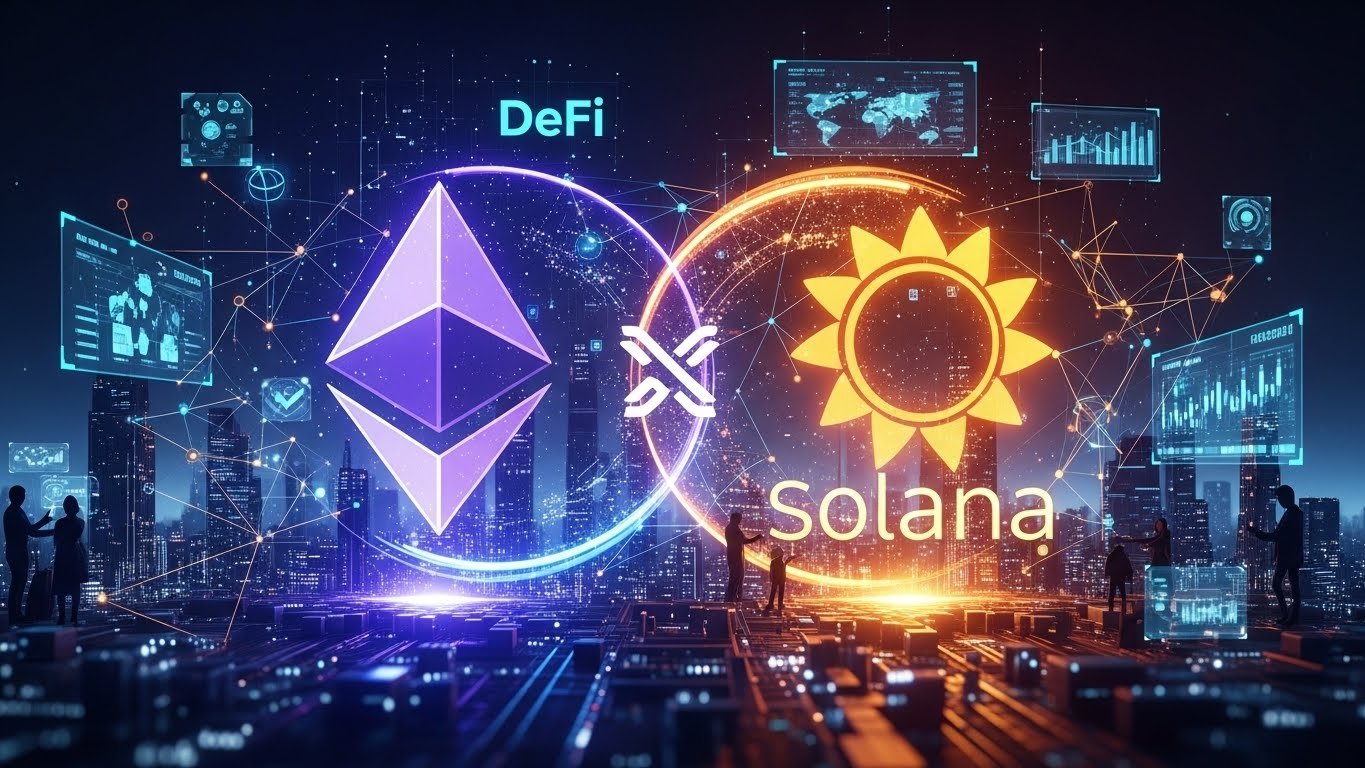
Ethereum remains the dominant platform for decentralized finance, hosting the largest share of DeFi protocols, liquidity, and developer activity. Its first-mover advantage established standards for smart contracts, tokenization, and composability that still define the ecosystem today.
Despite challenges such as high fees and network congestion in the past, Ethereum’s commitment to continuous improvement has preserved its central role. The network’s security, decentralization, and mature tooling make it a trusted foundation for high-value financial applications.
Layer-2 solutions and scalability breakthroughs
One of Ethereum’s most significant contributions to the DeFi reboot is the expansion of layer-2 solutions. These scaling networks process transactions off the main chain while inheriting Ethereum’s security, dramatically reducing costs and increasing throughput. As layer-2 adoption grows, DeFi applications become more accessible to everyday users. Lower fees enable smaller transactions, frequent interactions, and more complex financial strategies without prohibitive costs. This scalability is essential for Ethereum to support a global DeFi ecosystem by 2026.
Solana’s performance-driven DeFi vision
High throughput and low-cost design
Solana approaches DeFi from a performance-first perspective. Its architecture is designed to handle thousands of transactions per second with minimal fees, making it well-suited for high-frequency trading, real-time applications, and consumer-facing financial products. This performance advantage attracts developers building applications that require speed and responsiveness. As DeFi evolves beyond niche users, Solana’s capabilities align with the demands of mainstream adoption.
Rebuilding trust and infrastructure
Solana has faced its own challenges, including network stability issues in the past. However, ongoing improvements and refinements are strengthening its reliability. The ecosystem’s focus on tooling, developer experience, and robust infrastructure supports its role in the DeFi reboot. By 2026, Solana aims to be a platform where DeFi feels seamless and intuitive, removing many of the technical barriers that have limited adoption.
Ethereum and Solana as complementary ecosystems
Different strengths, shared goals
Rather than competing in isolation, Ethereum and Solana contribute complementary strengths to decentralized finance. Ethereum excels in security, decentralization, and institutional credibility, while Solana offers speed, affordability, and performance. This diversity allows developers and users to choose platforms based on their needs. Cross-chain technologies further enhance this synergy, enabling liquidity and functionality to flow between ecosystems.
Cross-chain interoperability and liquidity
Interoperability is a critical element of the DeFi reboot. As Ethereum and Solana ecosystems mature, seamless interaction between chains becomes increasingly important. Cross-chain liquidity solutions and messaging protocols allow users to access opportunities across networks without friction. This interconnected environment supports a more resilient and efficient DeFi landscape by 2026.
Innovation driving the 2026 DeFi reboot
Advanced financial primitives
The next phase of DeFi is characterized by more sophisticated financial products. Ethereum and Solana are hosting innovations in decentralized derivatives, structured products, and automated risk management systems. These advanced primitives move DeFi closer to institutional-grade finance while preserving transparency and openness. Improved design reduces systemic risk and enhances user confidence.
Real-world asset integration
Tokenization of real-world assets is another key driver of DeFi’s evolution. From commodities to real estate and traditional securities, integrating off-chain value into on-chain systems expands DeFi’s relevance. Ethereum’s established standards and Solana’s efficiency both play roles in supporting these use cases. Real-world asset integration bridges decentralized finance with the global economy, reinforcing the reboot narrative.
Developer ecosystems and tooling advancements
Ethereum’s mature developer community
Ethereum’s developer ecosystem is one of its greatest strengths. Extensive documentation, testing frameworks, and community support lower barriers to innovation. This maturity fosters experimentation while maintaining best practices. As DeFi rebuilds, experienced developers contribute lessons learned from earlier cycles, improving protocol design and security.
Solana’s focus on performance-oriented development
Solana attracts developers seeking to build fast and scalable applications. Its tooling emphasizes efficiency and real-time interaction, enabling new DeFi experiences that feel closer to traditional financial apps. This focus broadens DeFi’s appeal, supporting consumer adoption and novel use cases that were previously impractical.
User experience as a defining factor
Simplifying DeFi for mainstream users
One of the biggest barriers to DeFi adoption has been complexity. Wallet management, gas fees, and fragmented interfaces discouraged many potential users.
Ethereum and Solana ecosystems are addressing this by improving wallet design, abstraction layers, and user onboarding. A smoother experience is essential for the DeFi reboot to reach beyond crypto-native audiences.
Security, trust, and education
User trust depends on security and understanding. As DeFi evolves, education and transparent design become priorities. Clear risk disclosures and intuitive interfaces help users make informed decisions.By focusing on these elements, Ethereum and Solana contribute to a safer and more approachable DeFi environment by 2026.
Institutional interest and regulatory alignment
Growing institutional participation
Institutions are increasingly exploring decentralized finance for efficiency and innovation. Ethereum’s credibility and Solana’s performance offer attractive entry points for institutional experimentation. Institutional participation brings liquidity, standards, and long-term commitment, reinforcing the stability of the DeFi reboot.
Regulatory awareness and compliance
While DeFi remains decentralized, awareness of regulatory expectations is shaping protocol design. Compliance-friendly features and transparent governance help align decentralized systems with evolving regulations. Ethereum and Solana ecosystems are better positioned to adapt to these realities, supporting sustainable growth.
Security and systemic risk
Despite improvements, DeFi still faces risks related to smart contract vulnerabilities and interconnected protocols. Continued auditing and cautious design are essential. Ethereum and Solana must maintain a balance between innovation and security to ensure the reboot does not repeat past mistakes.
Market cycles and adoption uncertainty
DeFi adoption is influenced by broader market conditions. Volatility and macroeconomic factors can impact growth trajectories. However, a focus on real utility rather than speculation increases resilience across cycles.
Looking toward 2026 and beyond
Long-term vision for decentralized finance
The DeFi reboot led by Ethereum and Solana is about building infrastructure that lasts. By 2026, decentralized finance may function as a parallel financial system rather than a speculative niche. This vision includes global accessibility, transparent markets, and programmable financial services integrated into everyday life.
Ethereum and Solana’s lasting impact
As foundational platforms, Ethereum and Solana will shape how decentralized finance evolves. Their technical choices, communities, and ecosystems influence standards adopted across the industry. Their role in setting the stage for the DeFi reboot underscores their importance in the future of blockchain finance.
Conclusion
As the crypto industry matures, Ethereum and Solana set the stage for 2026’s DeFi reboot by addressing the shortcomings of earlier decentralized finance models and building toward a more sustainable future. Ethereum’s security, decentralization, and ecosystem depth combine with Solana’s speed, efficiency, and user-focused design to redefine what DeFi can become.
The reboot is not a return to unchecked speculation but a progression toward usable, scalable, and trustworthy financial infrastructure. By focusing on innovation, interoperability, and user experience, Ethereum and Solana are laying the groundwork for decentralized finance to thrive in the years ahead.
FAQs
Q: Why are Ethereum and Solana considered central to the DeFi reboot in 2026?
Ethereum and Solana are central because they represent the most mature and actively developed smart contract ecosystems. Ethereum provides security, decentralization, and institutional trust, while Solana offers high performance and low costs, together supporting diverse DeFi use cases.
Q: How will the DeFi reboot differ from earlier DeFi cycles?
The DeFi reboot focuses on sustainability, security, and usability rather than purely high yields. Protocols are being designed with better risk management, clearer user interfaces, and real-world utility, reducing reliance on speculative incentives.
Q: What role do layer-2 solutions play in Ethereum’s DeFi future?
Layer-2 solutions enable Ethereum to scale by reducing transaction costs and increasing throughput. This makes DeFi applications more accessible and practical for everyday users, supporting broader adoption by 2026.
Q: Can Solana compete with Ethereum in decentralized finance?
Solana competes by offering speed and affordability, attracting developers building performance-intensive applications. Rather than replacing Ethereum, Solana complements it, with both ecosystems contributing to a diverse DeFi landscape.
Q: What challenges could slow down the DeFi reboot?
Challenges include security risks, regulatory uncertainty, and broader market volatility. Addressing these issues through careful design, transparency, and education is essential for the DeFi reboot to succeed.
